index this!

Walt writes that he is done with C&I Volume 5. If you’re a reader of Cites & Insights, you’ve probably already downloaded and printed out the latest issue, as have I (though I haven’t read it all yet). I was particularly delighted, however, to be able to download and print out the index [.pdf] to the whole volume.

I love indexes (or indices, if you prefer). So far as I know, the C&I index is the first one in which I appear, which gives it a certain added appeal, but I like pretty much any old index.

For one thing, an index is kind of a paper version of a tag cloud. Go pull a biography off the shelf and flip through the index. Chances are that some terms will have several lines of pages listed after them, while some will have only one or two. Some will also have sub-index terms underneath, rather like the sub-subjects in the OPAC tag cloud that everyone’s been talking about. I’ve also always thought that a good index reads rather like a bit of found poetry.

And then, of course, there’s what I have always considered to be the greatest literary reference to indices: Chapter 44 of Kurt Vonnegut’s Cat’s Cradle, called “Never Index Your Own Book.”

“It’s a revealing thing, an author’s index of his own work,” she informed me. “It’s a shameless exhibition—to the trained eye.”
“She can read character from an index,” said her husband.
“Oh? I said. “What can you tell about Philip Castle?”
She smiled faintly. “Thing’s I’d better not tell strangers.”

Want to know what? Well, as we say in my readers’ advisory class, if you want to find out, you’ll have to read the book.

Technical notes for this entry: I’m trying Blogger for Word for the first time. We’ll see how it works. [Update: I wrote this in Word, but I’m going to be posting via Blogger, since so far as I can see, Blogger for Word is not for Mac. Furthermore, I was unable to cut and paste from Word to Blogger, so I had to cut and paste to Text Edit, then cut and paste from there to Blogger, then put in all the links again. Poopy.] I consulted several books in the course of writing this entry—a dictionary, because I was curious about whether there was a preferred plural form for the word index (not really, though indexes was listed first in The American Heritage Dictionary, Second College Edition, (Boston: Houghton Mifflin, 1991), which was what happened to be closest), and a copy of Cat’s Cradle, because I couldn’t remember the exact title of the chapter, and because I wanted to use a quotation. I know there are many wonderful online dictionaries, both free and fee, plus of course that handy Google operator, define: X, but I never think to use them. It did occur to me to try out Google Book Search to see if Cat’s Cradle had been scanned, which it doesn’t seem to have been, though there are plenty of books that reference it. A search for “never index your own book,” however, did turn up this little gem, which I’d love to read. Google, oh, Google, why do you not synch yourselves with Find in a Library?
she’s such a geek

Are you a geek, and a writer, and a female? Why not submit an essay to a book called She’s Such a Geek, forthcoming from Seal Press next fall.

This anthology will celebrate women who have flourished in the male-dominated realms of technical and cultural arcana. We’re looking for a wide range of personal essays about the meaning of female nerdhood by women who are in love with genomics, obsessed with blogging, learned about sex from Dungeons and Dragons, and aren’t afraid to match wits with men or computers. The essays in She’s Such a Geek will explain what it means to be passionately engaged with technical or obscure topics-and how to deal with it when people tell you that your interests are weird, especially for a girl. This book aims to bust stereotypes of what it means to be a geek, as well as what it means to be female.

Thanks to pasta, you can read the full call for submissions. Thanks to Mitchell for forwarding it.

what help “the help” can offer

I am still on a few mailing lists left over from my time as a graduate student at the University of Iowa. The other day, someone wrote to one about her experience taking a class on Extreme Web Searching at the UI Library, and she kindly gave me permission to reprint her remarks on the experience.

I signed up for this nerdy class at the library to learn about search engines beyond everyone’s fav, Google, and to my surprise, the class was fascinating. There are a whole slew of search engines apart from Mister Google, and they’re doing remarkable things. (They also have bizarre names like Clusty, Teoma, and Dogpile.) Since many of y’all research when you’re not writing, and since others may enjoy a nice vanity-search, I thought I’d pass on the links. This page should be live for a while.

http://myweb.uiowa.edu/sostrem/xtreme.html

If nothing else, give KARTOO a whirl. I put in the name of the person I’m interviewing [for a conference] and thought I was bugging out when my results “map” appeared. http://www.kartoo.com/

One might, I suppose, take this as evidence of librarians having done a poor job of marketing themselves as purveyors of useful and cool knowledge (i.e., a graduate student is surprised by what she can learn at the library?), but I am chosing to see it in a much more positive light. You see (and I’m admitting this here for the first time, at least in print), until I actually started library school, I was one of those people who thought the library had nothing to teach me. The more fool I. I’m glad to see that not everyone is as ignorant as I was, or as unwilling to take a chance on the idea that they might learn something from “the help.”

the tinfoil carnival

I am going to stop apologizing for being so late in posting new installments of the Carnival of the Infosciences. As others have mentioned (I’m thinking at the moment of Walt Crawford’s “Blogging Trumps Life” [edit 11/5/05: of course I actually meant “Life Trumps Blogging”–duh–thanks to Walt for noticing that little discrepancy] essay in the most recent Cites & Insights), the beauty of a) RSS and b) multiple people keeping an eye on things and writing about them is that we do not all have to be responsible for everything.

I am nevertheless greatly pleased to point you to the Carnival of the Infosciences #13, hosted by Rochelle Hartman of Tinfoil + Racoon. Enjoy!

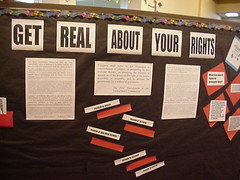
get real about your rights


get real about your rights 3
Originally uploaded by newrambler.

Here’s a photo of the display I did on teen rights at the library in honor of Teen Read Week (theme this year: “Get Real”) and The September Project (I put it up back in September and spent a month adding to it).

Andrea Mercado did a very nice post about this display and another one I did over on the PLA Blog (thanks!).

on the uses of the biblioblogosphere

I started browsing around in the biblioblogosphere sometime during winter break last year. I had heard of librarian.net and Librarian Avengers and a few others from various sources, but when I dove in to the land of links, I really had no idea who any of these people were. And as I started reading, I had no idea who all the people they talked about were. Who was this Walt Crawford person, and why was everyone so excited when he got a blog? I had a hard time lining up real names and blog names for awhile–was Jenny the Shifted Librarian or the Librarian in Black, or maybe the Free Range Librarian? And what the hell was all this RSS stuff everyone kept talking about? Feeds? Subscriptions? Aggregators? It was code to me; code being spoken by a group of people in the know, all of whom seemed to know each other and refer to one another in endless loops. In many ways, then, it was like a clique–like one of those supercool groups of people I never quite belonged to. But in important ways it was different from a clique–it existed (mostly) in virtual space, and, perhaps by virtue of that, it was a club that anyone could join. I never felt excluded in my early months of reading; I just felt like I was getting the lay of the land.

Eventually I started to figure it out. Bloglines! What a nifty tool! RSS goodness, as so many of the people I read would say. I figured out who was who. I started using my incredible printing privileges at school (they let you print out unlimited amounts of stuff for free–it’s crazy, but hard not to like) to print out Cites & Insights. And then, perhaps inevitably, I started a blog of my own.

Now, thanks to Michael Stephens of Tame the Web, there are a bunch of Dominican students blogging. (Hi, Natalie and Connie and probably some others of who whom I know but am forgetting!) I stopped thinking of this as a sort of unofficial Dominican forum and started thinking of it as my own little personal domain awhile back. I had the great privilege and pleasure of meeting a whole bunch of the people whom I had myself started to refer to casually at the bloggers’ shindig at ALA (thanks again to It’s all good for sponsoring the party, and thanks to Walt for sharing cab fare up to the Loop).

I’ve been thinking a lot about all of this while reading various people’s reactions to the Nielsen weblog usability article over the past week or so. I won’t reiterate the excellent critiques made by Mark and Angel, but I will say this: I never felt unwelcome by the first blogs I read (my blog parents, as Rochelle so charmingly put it). I didn’t understand everything I read, but it wasn’t because people were using too much jargon or acting too clique-ish. I didn’t understand everything I read because I was new to the biblioblogosphere and new to librarianship. I liked what I read; I liked figuring it out; and, most of all, I liked the feeling that I was entering a community I was welcome to join.

There aren’t many places in the world where you can get by–get ahead, if you want to think of it that way–simply on the strength of your ideas and your willingness to express them. The biblioblogosphere turns out to be one of those places. I’m immensely grateful for that. I haven’t been blogging much lately–the whole life trumps blogging thing that many have experienced–but I still dip in and sometimes dive in to this wonderful set of waterways that all of you have built. One way or another, I plan to keep on tumbling through it, and I hope that next June, one way or another, many of you will all wash up in New Orleans.

carnivals and dereliction of duty

I am so woefully behind that I have even neglected the marvelous Carnival of the Infosciences. I am sure that, due to the wonders of the biblioblogosphere, you have picked them all up elsewhere, but to give them the credit they richly deserve, here they are:

Carnival of the Infosciences #8 at The Industrial Librarian
Carnival of the Infosciences #9 at . . .the thoughts are broken. . .
Carnival of the Infosciences #10 at A Wandering Eyre
Carnival of the Infosciences #11 at Christina’s LIS Rant

And there’ll be another one tomorrow!

my mantra

Here’s the post I wrote in Writely sometime back. Life has become more hectic since then, but I offer this to tide you over for awhile.

Everyone has their own set of frustrations (often with technology, sometimes with life in general). I’ve had my share over the past few weeks, too numerous and dull to mention, and thus instead I offer you today my favorite frustration mantra. You can find it at the very end of The Jungle Book, by Rudyard Kipling.

COMMISSARIAT CAMELS

We haven’t a camelty tune of our own
To help us trollop along,
But every neck is a hairy trombone
(Rtt-ta-ta-ta! is a hairy trombone!)
And this is our marching song:
Can’t! Don’t! Sha’n’t! Won’t!
Pass it along the line!
Somebody’s pack has slid from his back,
Wish it were only mine!
Somebody’s load has tipped off the road,
Cheer for a halt and a row!
Urr! Yarrh! Grr! Arrh!
Somebody’s catching it now!

Note: One should really always try searching the Web before typing. I was just trying to find a nice Open WorldCat record to link to, and I found that (not surprisingly) there are full-text versions of the whole book available from Project Gutenburg and the University of Virginia. The UVA one even includes the proper italicizations, which the Gutenburg version lacks.

Design a site like this with WordPress.com
Get started